
Book Appointment Now

Nose Filler Treatments in London
The nose sits at the centre of facial proportion, and even subtle structural irregularities — a dorsal hump, a crooked nasal profile, or an undefined tip — can affect how the whole face reads at rest. Non-surgical rhinoplasty uses dermal filler to address these concerns directly, reshaping the nose without surgery through precise, controlled injection into specific areas of the nasal structure.
For patients researching non-surgical nose fillers in London, the clinical approach matters considerably more than product volume alone. A filler nose job works by redistributing visual contour and improving the shape relative to the surrounding facial structure, which requires careful anatomical assessment before anything is injected.

Consultation and Pricing
Treatment suitability, the personalised plan, and final cost are confirmed after consultation and clinical assessment. Pricing depends on individual anatomy, treatment scope, the type of filler used, the amount of product required, and clinical complexity.
The figures below represent general market guidance based on publicly advertised London prices reviewed in June 2026 across 7 clinics. These are not our clinic’s prices and may not reflect consultation fees, promotional pricing, product volume differences, technique variation, or individual treatment planning.
London market guide — Nose Filler Prices
- Standard non-surgical rhinoplasty (0.5–1ml): about £350–£720
- Minor nose correction or tip refinement only: about £290–£450
- Bridge and asymmetry correction: about £450–£720
- Review or top-up session: about £150–£300
Before and After Nose Filler Treatment
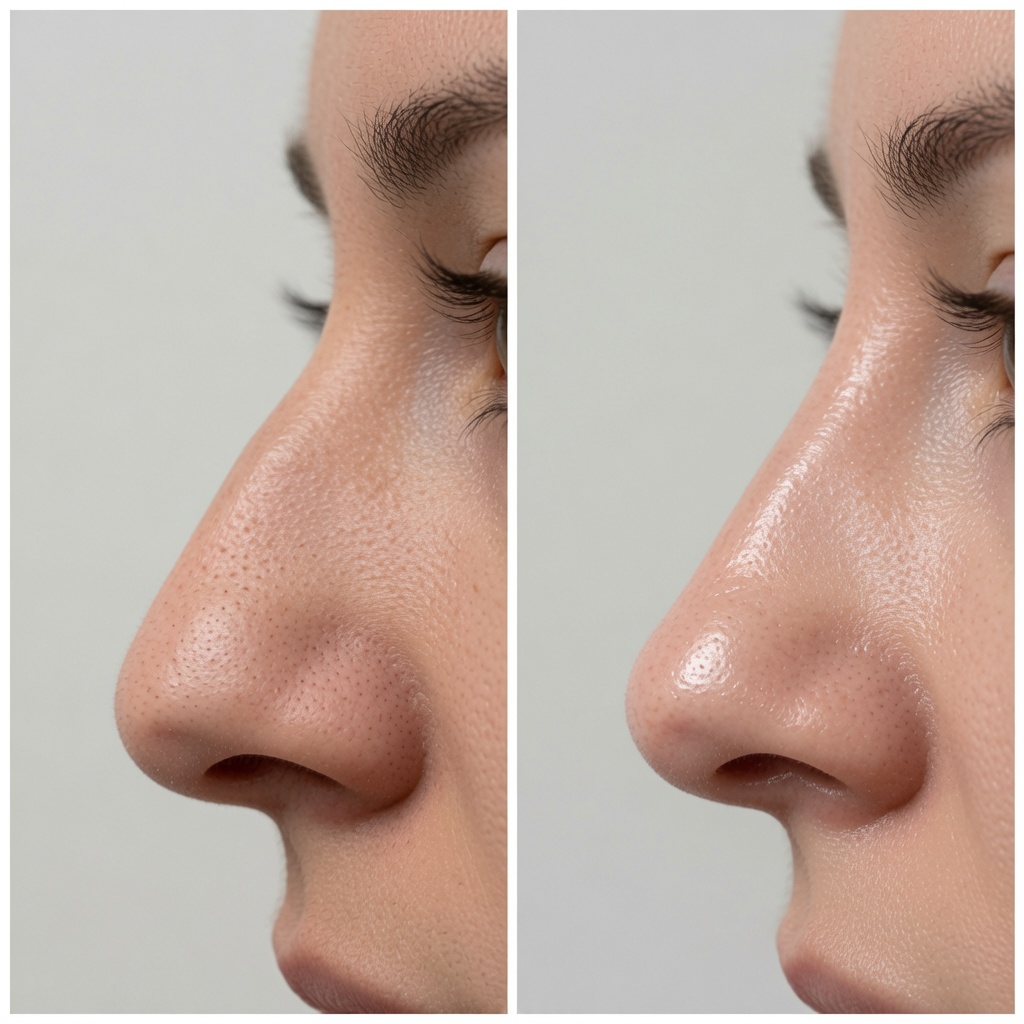
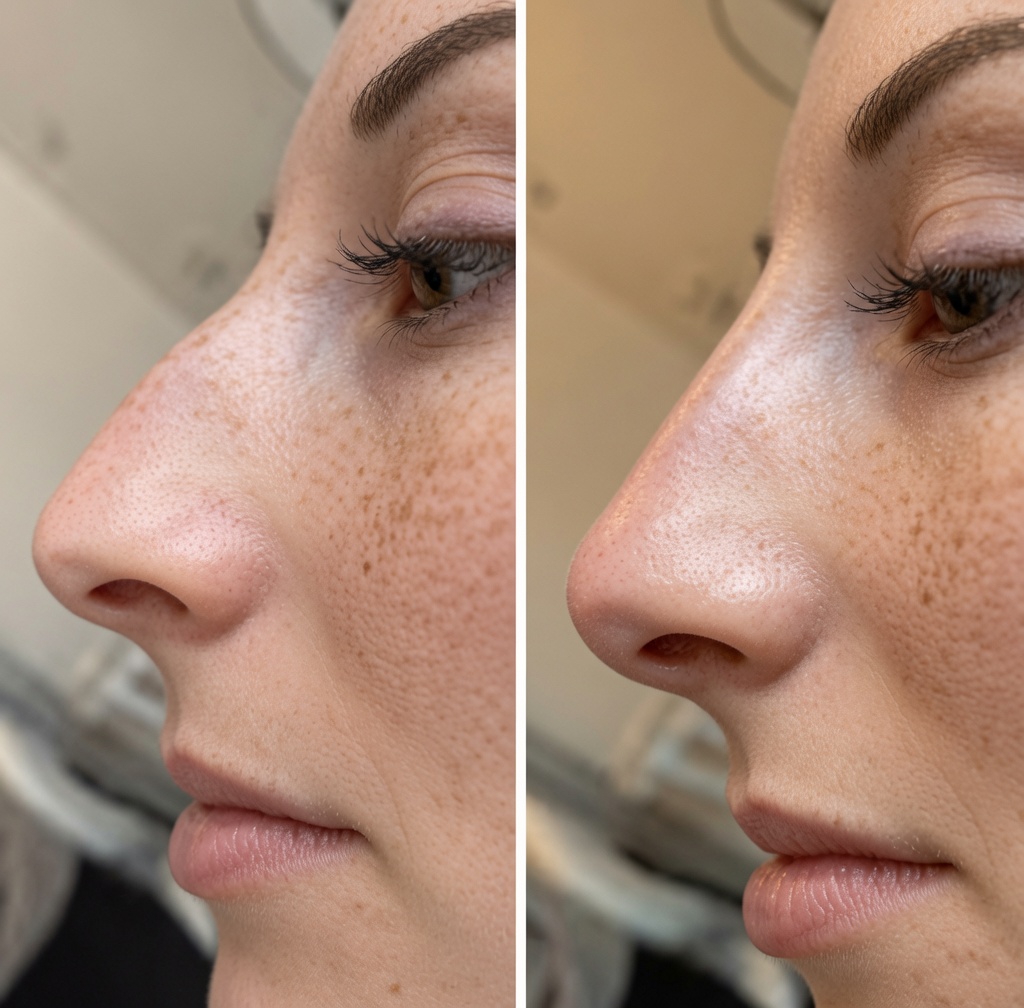
Results from non-surgical nose reshaping are visible immediately after treatment. As the product settles over the following one to two weeks, the final nasal shape becomes fully apparent, with any mild initial swelling resolving to reveal a more balanced, refined outcome.
Patients typically describe a smoother profile, improved symmetry, a more defined tip, and a more harmonious relationship between the nose and the rest of the face.
Visible improvements patients commonly report:
- A smoother bridge with reduced prominence of humps or dorsal irregularities
- Improved nasal symmetry and correction of a mildly crooked nose
- A more defined or elevated tip without a surgical procedure
- Better overall facial proportion and a more balanced front-facing nasal profile
What is Nose Filler?
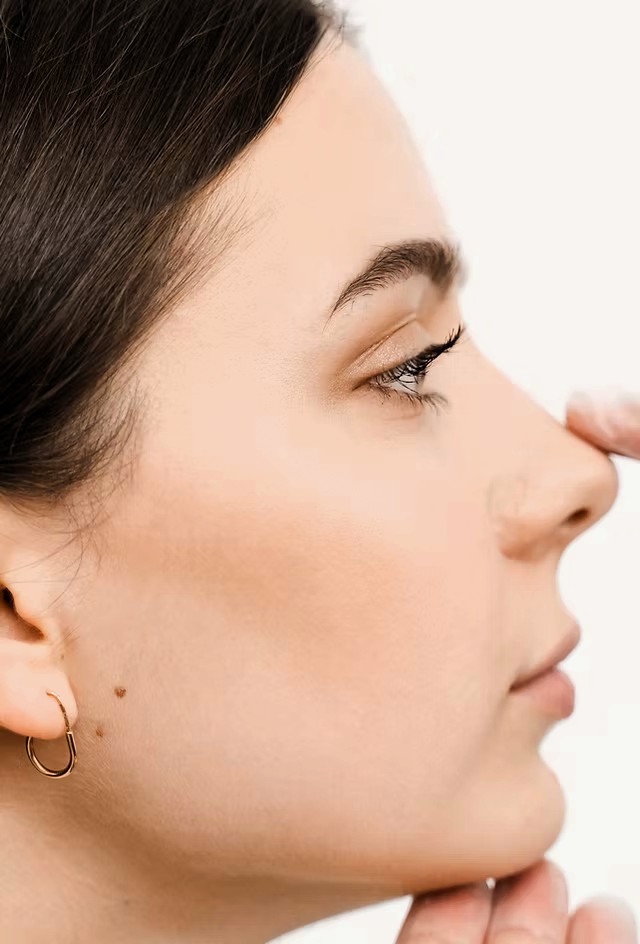
Nose filler refers to the clinical use of injectable dermal filler — most commonly a cohesive hyaluronic acid filler — to reshape and enhance the nose without surgical rhinoplasty. Hyaluronic acid integrates naturally with tissue, supports precise contouring, and can be dissolved if required.
Unlike surgical rhinoplasty, a non-surgical nose job involves placing small amounts of filler into specific areas to create optical corrections. Adding product strategically along the nasal bridge, around the contours, or at the tip can create a straighter nasal line, improve symmetry, or produce the illusion of a smaller nose by improving overall proportion.
The filler type used in nasal treatment matters clinically. A cohesive hyaluronic acid filler with appropriate lift capacity is typically selected to support the nasal profile without migration. This distinguishes advanced correction from less considered approaches, and is part of what makes thorough assessment central to achieving a well-proportioned, long-lasting result.
Key characteristics of filler treatment:
- Cohesive hyaluronic acid filler used for tissue compatibility and controlled placement
- Delivered via precise filler injections into targeted nasal zones
- No incisions, no general anaesthesia, no surgical recovery period
- Results visible immediately, with full settling over one to two weeks
- Reversible with hyaluronidase, where clinically indicated
The Nose Filler Process: Step by Step
01
Initial Consultation
A face-to-face consultation explores nasal concerns, aesthetic goals, clinical suitability, and relevant medical history. Where prescription products are required, Dr. Ivan provides this assessment.
02
Clinical Assessment and Treatment Planning
The nasal anatomy, skin quality, and facial proportions are evaluated. A personalised treatment plan confirms the injection approach, product volume, and the specific areas of the nose to be treated.
03
Pre-Treatment Preparation
The treatment area is cleansed and a topical anaesthetic is applied to minimise discomfort, particularly around the tip and bridge, before injections begin.
04
Treatment Delivery
Filler is injected precisely across the agreed nasal zones. The amount required is confirmed during assessment, and sessions typically take between 15 and 30 minutes.
05
Aftercare and Recovery Guidance
Specific aftercare is provided at the end of each session, including guidance on avoiding pressure on the nose, sun exposure, and strenuous activity in the days that follow.
Procedure time: 15–30 minutes.
Recovery: Minimal downtime expected. Mild swelling or tenderness typically resolves within 24 to 72 hours, with the final nasal shape visible within one to two weeks.
Benefits of Nose Filler
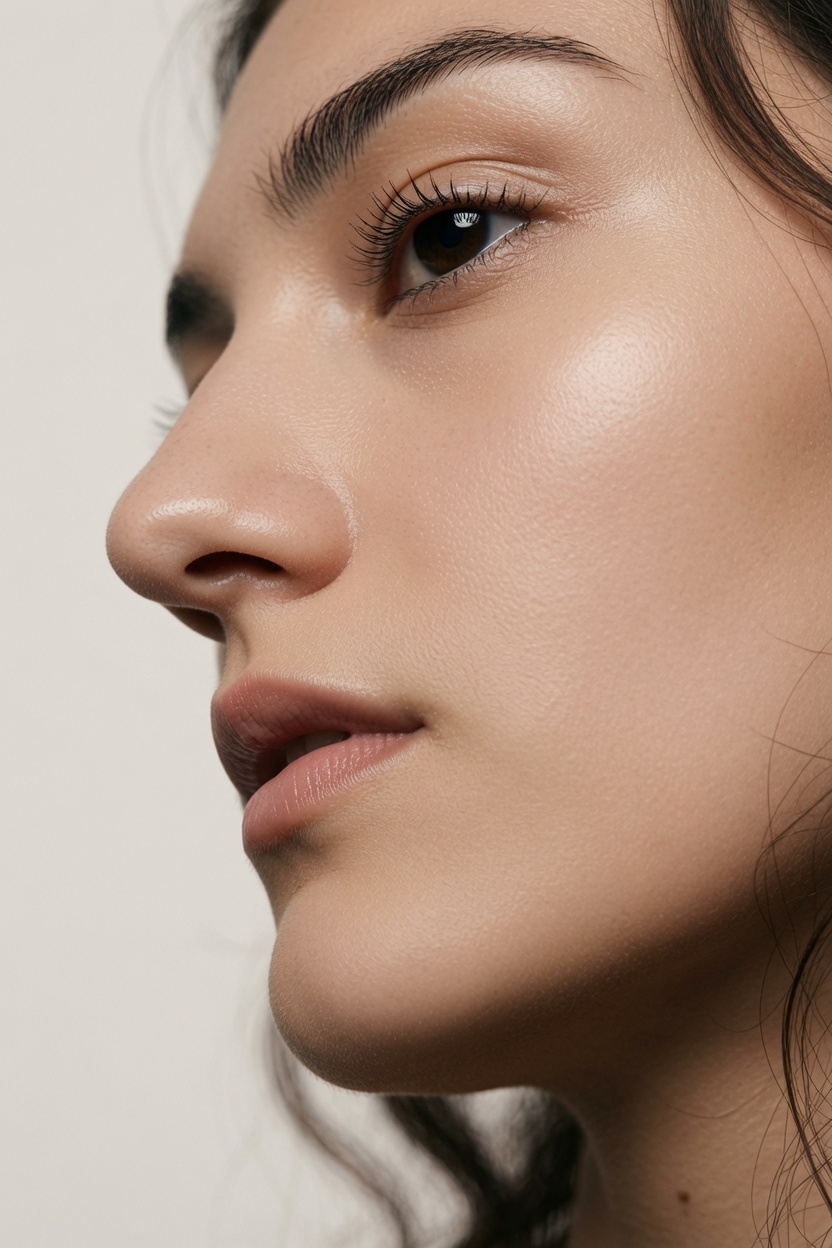
Non-surgical rhinoplasty in London offers a clinically structured way to refine the nose and enhance your nasal proportions without the recovery demands of a surgical procedure. For patients with a visible dorsal hump, a crooked nose, or an undefined tip, targeted filler injections can produce meaningful changes in shape and facial balance.
Unlike surgical rhinoplasty, a non-surgical nose job involves minimal downtime and no general anaesthesia. It suits patients who wish to reshape and enhance the nose gradually, or who want to assess the visual effect of non-surgical reshaping before considering surgical and non-surgical options more formally.
Because fillers to reshape the nose work through redistribution rather than removal, the treatment cannot reduce its physical size. It can, however, create the illusion of a smaller nose by improving symmetry, lifting the tip, and straightening the bridge — outcomes that often matter more than the absolute size.
Key benefits of non-surgical reshaping:
- Reshapes and refines the nose without a surgical procedure or general anaesthesia
- Corrects dorsal irregularities, asymmetry, and tip definition using targeted dermal filler treatments
- Reversible — the filler type used is hyaluronic acid, dissolvable with hyaluronidase if required
- Minimal downtime with most patients resuming normal activity the same day
- Complements broader facial balancing as part of a wider aesthetic plan
Nose Filler Treatment Options
Option One: Targeted Bridge or Hump Correction
A focused non-surgical nose job in London addressing a specific structural concern — typically a dorsal hump or asymmetry along the bridge. Injecting filler precisely in this single zone redistributes the nasal profile, and is often achievable in one session with reassessment once the product settles.
Option Two: Full Nasal Reshaping Protocol
A comprehensive approach to enhancement covering the bridge, tip, and overall nasal profile in a single coordinated session. Suited to patients with several overlapping concerns — including a crooked nose, a flat bridge, or an undefined tip — where addressing the nose as a whole produces the most harmonious result.
Option Three: Combined Nose and Facial Balancing
An advanced filler treatment pairing non-surgical reshaping with complementary dermal filler in the chin, jawline, or midface to refine overall facial structure. Appropriate where nasal appearance is closely linked to surrounding proportions, and where a broader treatment plan produces the most naturally balanced nose enhancement.
Summary of available treatment approaches:
- Targeted correction for isolated bridge or hump concerns
- Full nasal reshaping covering nose profile, bridge, and tip
- Liquid nose job as a standalone non-surgical rhinoplasty treatment
- Combined nasal and facial balancing for patients with wider proportional concerns
- Course-based planning where staged sessions support gradual, considered nose filler in London
Why Choose Us?
Angelika brings over eight years of international medical experience to each treatment. Her approach to non-surgical rhinoplasty for London patients combines technical precision with an understanding of individual nasal anatomy and the restraint that nose filler injections demand.
Her practice operates within UK certification and insurance standards, integrating internationally developed injection techniques within a structured clinical framework. Every result is built around individual anatomy rather than a formulaic approach.
Where prescription-only products are clinically required, Dr. Ivan provides face-to-face consultation and prescribing through a compliant, structured pathway. Every treatment plan is confirmed through clinical assessment, not a predetermined protocol.
The clinic is based in central London, offering continuity of care and accessible follow-up for patients seeking consistent, experienced non-surgical rhinoplasty in London.
What distinguishes our approach:
- Over 8 years of international medical experience in the filler technique
- Advanced aesthetic practice aligned with UK certification, insurance, and safety standards
- GMC-registered prescribing support from Dr. Ivan where clinically required
- Personalised treatment planning confirmed through thorough clinical assessment
- Evidence-based approach to nose filler — not volume-led or trend-driven
- Central London clinic with consistent professional standards and accessible ongoing review
Disclaimer: Angelika is an aesthetic practitioner, not a medical doctor. Where prescription-only products are clinically appropriate, face-to-face consultation and prescribing are provided by GMC-registered prescriber Dr. Ivan. This treatment is available to patients aged 18 and over.
Frequently Asked Questions
How long does a nose filler last?
Results from non-surgical rhinoplasty typically last between 12 and 18 months, depending on the filler type used, the volume injected, and individual metabolism. The nasal area is moderately dynamic, and the product may disperse more quickly than in less mobile facial zones. A clinical reassessment helps determine appropriate timing for maintenance. Lifestyle, skin quality, and age all influence how long the enhanced appearance remains stable.
Is nose filler safe?
Non-surgical nose reshaping carries specific risks because the nasal anatomy includes a dense and complex vascular supply. Vascular occlusion — where the product is inadvertently placed near a blood vessel — is the most serious potential complication and requires immediate clinical management. This is why assessment of individual anatomy, conservative volumes, and access to hyaluronidase are essential. At this clinic, no treatment proceeds without a thorough face-to-face consultation confirming clinical suitability.
What are the risks associated with a nose filler?
The most significant risk of nose filler injections is vascular occlusion, which can restrict circulation and, if unmanaged, cause tissue damage or, in rare cases, visual disturbance. Skin necrosis has been reported in the medical literature. Less severe but more common effects include bruising, mild asymmetry, and nodule formation as the product settles. Appropriate practitioner training, conservative volumes, careful injection technique, and immediate access to hyaluronidase are essential risk-mitigation factors in responsible nasal correction.
How much filler is typically needed?
Most treatments use between 0.5ml and 1ml of cohesive hyaluronic acid filler. Minor nose correction — such as an isolated tip refinement or smoothing of a small hump — may require less. The amount of product needed is confirmed during clinical assessment and forms part of a personalised treatment plan. Using the minimum effective volume is a core principle of responsible treatment, particularly given the anatomical sensitivity of the nose.
Does a nose filler hurt?
The nose is a sensitive area, and mild discomfort during filler injections is common, particularly around the tip and along the bridge. A topical anaesthetic is applied in advance, and the hyaluronic acid product used typically contains lidocaine to further reduce sensation during delivery. Most patients find the experience tolerable. Any tenderness at the injection site generally resolves within a few hours. Your practitioner will adjust technique and pacing throughout to keep the procedure as comfortable as possible.
Is there downtime after a non-surgical nose job?
Non-surgical rhinoplasty involves minimal downtime for most patients. Mild swelling, tenderness, or minor bruising is common and typically resolves within 24 to 72 hours. Immediately after treatment, the nose may look slightly uneven before the filler settles — this is a normal part of the early recovery phase. Patients are advised to avoid pressure on the area, glasses where possible, strenuous exercise, and direct heat for at least 24 hours. Most return to daily activity the same day.
Who is a suitable candidate for non-surgical rhinoplasty in London?
Non-surgical rhinoplasty London patients most suited to treatment are adults wishing to address a dorsal hump, mild asymmetry, a crooked nose, or an undefined tip without a surgical nose job. It is also appropriate for those refining results following prior surgical rhinoplasty. Individuals who are pregnant, breastfeeding, or who have certain clotting disorders or active skin conditions in the nasal area may not be suitable. Suitability is confirmed only through a full face-to-face clinical consultation.
When will I see the final result?
Results from a non-surgical nose job are visible immediately after treatment, though initial swelling may temporarily affect the nasal appearance. The nose typically settles over one to two weeks as tissue integrates with the injected product. The final shape is assessed at a follow-up review approximately two weeks post-treatment. Where a staged approach is planned, the outcome of the first session is evaluated before any additional filler is considered, ensuring each step builds on a stable, settled nasal profile.