
Book Appointment Now

Dissolving Lip Filler Treatments in London
Unwanted or poorly placed lip filler can alter the natural lip shape, creating asymmetry, product migration, or an overfilled appearance that is difficult to conceal and affects overall facial balance. These outcomes arise from technique variation, product selection, or cumulative volume from previous treatments placed over time.
Hyaluronidase injection offers a clinically precise method of dissolving dermal filler and restoring the lip’s original architecture. At our central London clinic, lip filler dissolving is planned individually, with the dissolving process guided by anatomical assessment of the product location, the type of material used, and the degree of correction required.
Consultation and Pricing
Treatment suitability, the dissolving plan, and final cost are confirmed following consultation and clinical assessment, based on product volume, location, treatment complexity, and whether a single session will suffice.
The figures below are provided for general market guidance only, based on publicly advertised prices reviewed on 29 April 2026 across 5 London clinics. These are not our clinic’s prices and may not include consultation fees, promotional pricing, product differences, injection technique variation, or individual treatment planning.
- Lip filler dissolving (single area): about £290–£350
- Multiple area dermal filler correction: about £500–£650
- Complex revision with large amounts of accumulated product: about £800–£1,200
- Follow-up dissolving session, where required: about £150–£250
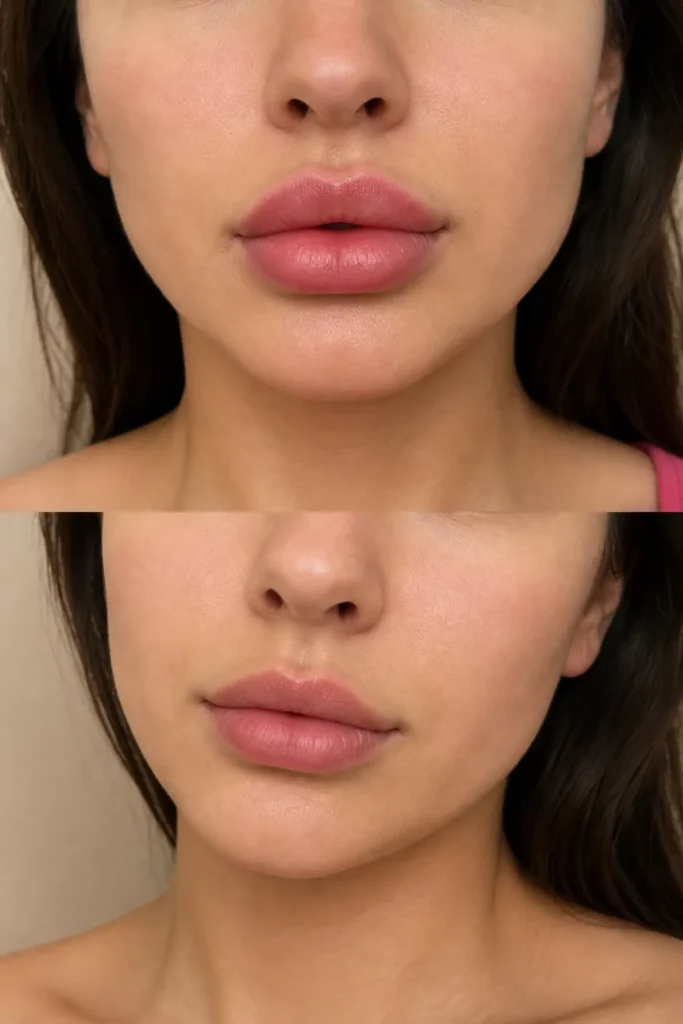
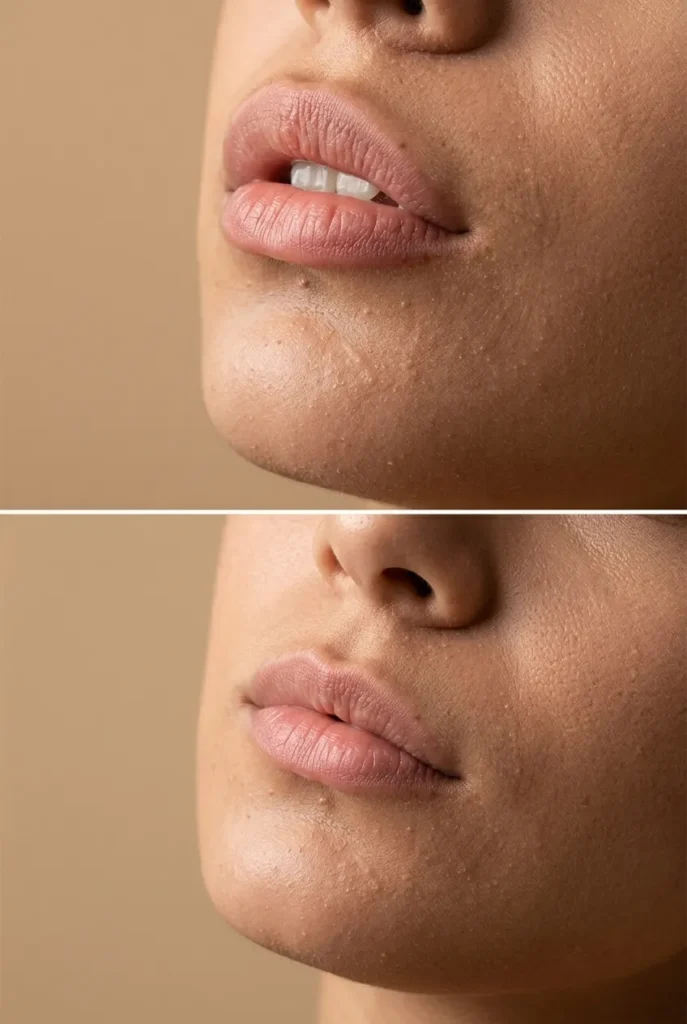
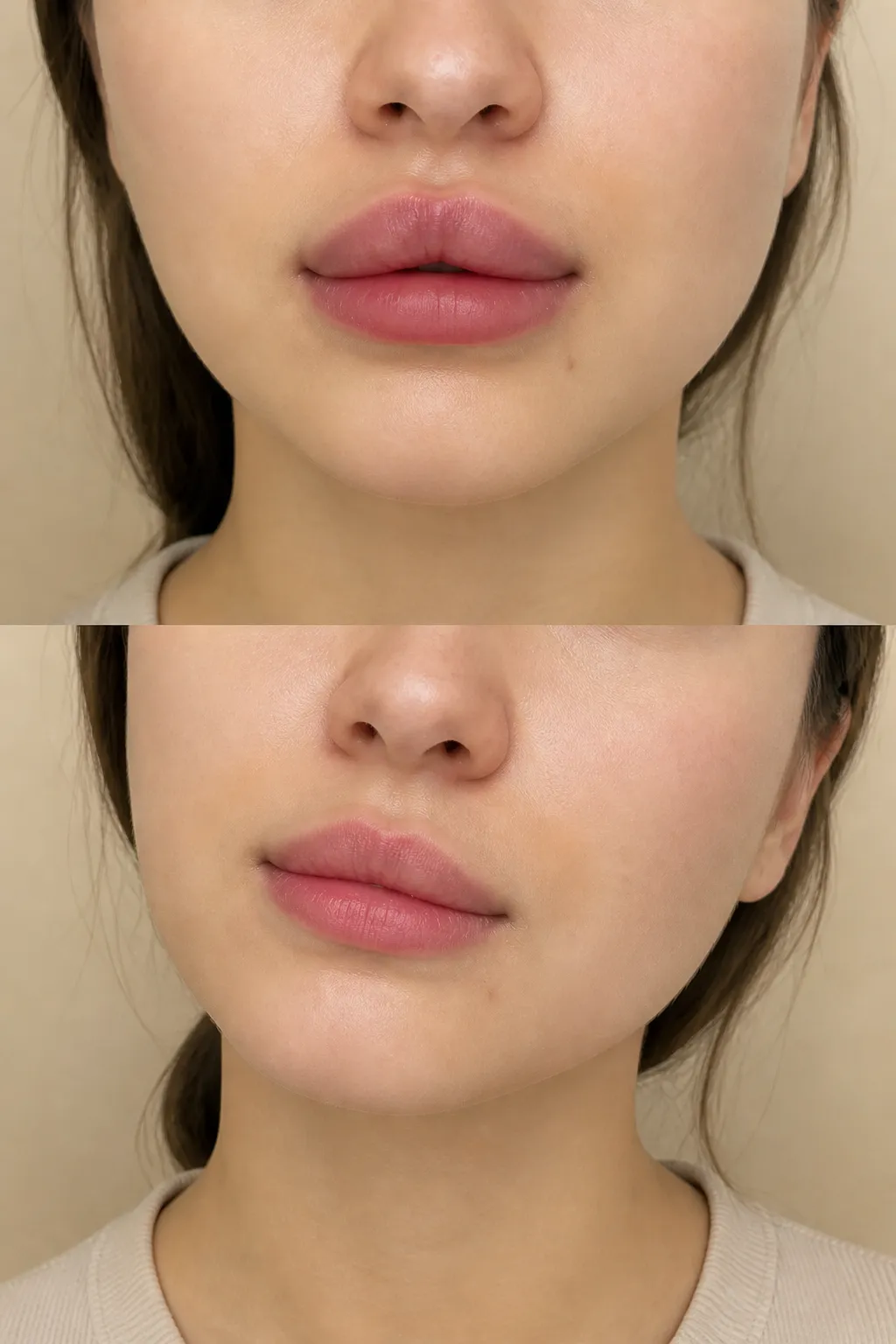
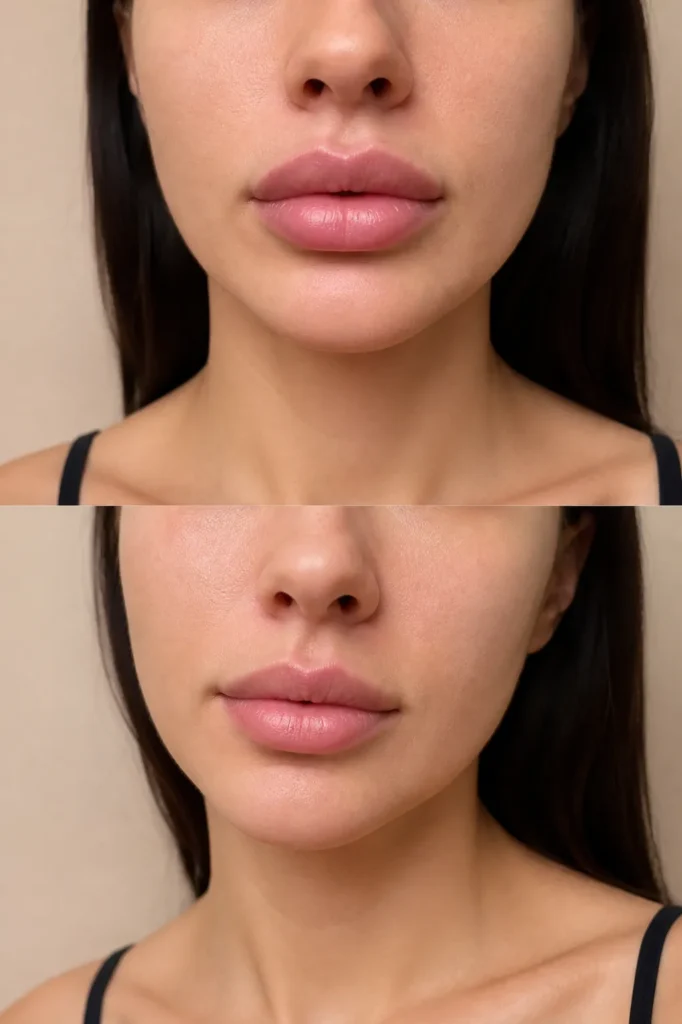
Before and After Dissolving Lip Filler Treatment
Before treatment, patients often present with visible overfilling, product migration above the natural lip line, persistent lumps, or marked asymmetry. In many cases, these outcomes are influenced by the amount of filler injected, the placement technique, and the characteristics of the product itself. The filler dissolving process works by introducing an enzyme that specifically targets hyaluronic acid filler, a key component of many dermal fillers used for lip augmentation.
After the dissolving injection, the hyaluronic acid material begins to break down within hours, helping to dissolve unwanted filler in a controlled and predictable manner while allowing the lip to gradually return towards its natural contour and proportion. This approach is effective for hyaluronic acid products, although permanent or semi-permanent fillers require a different clinical pathway, as they cannot be reversed with hyaluronidase.
Initial swelling following the hyaluronidase injection typically resolves within three to five days, after which the final result becomes clearer. In most cases, the lip’s natural shape is substantially restored within one to two weeks, and any decision about new lip filler can then be assessed from a stable baseline.
Key treatment outcomes:
- Reduction of unwanted volume and correction of overfilled contours
- Resolution of product migration and restoration of the natural lip line
- Improved symmetry between the upper and lower lip areas
- Stable baseline from which future lip augmentation can be planned accurately
What is Dissolving Lip Filler?
Lip filler dissolving is an injectable correction procedure in which hyaluronidase — an enzyme that breaks down hyaluronic acid — is introduced directly into the area where the filler has been injected. Because hyaluronidase cleaves the polymer chains within hyaluronic acid-based materials, the injected substance degrades and is reabsorbed naturally by the body.
The enzyme’s action is specific to hyaluronic acid. Many dermal fillers used in lip augmentation are hyaluronic acid-based, which means they can be reversed effectively using this approach. It is important to note that permanent or semi-permanent products cannot be dissolved with hyaluronidase, and these require separate clinical assessment.
Hyaluronidase is a prescription-only medicine and must be administered in a controlled clinical environment following a consultation and, where indicated, a patch test. This requirement reflects the potential for allergic reaction and the importance of using the correct enzyme dosage for each treatment plan.
The effectiveness of treatment depends on several clinical factors, including the type of hyaluronic acid filler used, the depth at which it was placed, and the amount of filler present in the tissue. More densely cross-linked formulations may require a carefully adjusted treatment protocol, while softer hyaluronic acid-based fillers often respond more readily to enzymatic breakdown. In some cases, more than one session may be recommended to fully dissolve fillers and achieve the desired correction.
Conditions typically addressed by dissolving treatment include:
- Overfilling and disproportionate lip volume
- Product migration beyond the natural vermilion border
- Visible lumps, nodules, or uneven distribution of injected material
- Persistent asymmetry following previous lip filler treatments
- Preparation for re-treatment with improved placement
The Dissolving Lip Filler Process: Step by Step
01
Initial Consultation
Previous treatments, concerns, medical history, and correction goals are reviewed in full. Suitability for hyaluronidase injection is assessed, and treatment expectations are discussed openly.
02
Clinical Assessment and Planning
The product location, estimated volume, and tissue condition are examined to determine the correct enzyme dosage and whether ultrasound-guided filler dissolving is clinically appropriate.
03
Pre-treatment Preparation
A patch test is administered where indicated. The treatment area is cleansed, a topical anaesthetic is applied, and clinical photographs are taken for the records.
04
Treatment Delivery
Hyaluronidase is injected into the targeted area using fine needles, with placement guided by the individual correction plan and clinical findings.
05
Aftercare and Recovery Guidance
Post-treatment instructions are provided, including guidance on avoiding pressure, heat, and active skincare ingredients during the initial recovery period. A review is offered where clinically appropriate.
Procedure time: 20–40 minutes.
Recovery: Mild swelling and tenderness typically resolve within three to five days; final contour becomes assessable within one to two weeks.
Benefits of Dissolving Lip Filler
For patients dealing with the effects of excess product, unwanted migration, or unsatisfactory results from previous lip filler treatments, hyaluronidase injection provides a targeted and clinically established correction route. The enzymatic process removes the injected material with a degree of precision that allows the natural lip shape to re-emerge without surgical intervention.
One of the most practical advantages of this lip filler dissolving treatment is its speed of action. Significant softening typically occurs within 24 to 48 hours of the injection, meaning that the correction process is comparatively rapid. This is particularly relevant where a patient wishes to proceed to a new treatment with improved placement following a settling period.
The availability of hyaluronidase as a dissolving agent also supports more considered decision-making in aesthetic medicine. Knowing that hyaluronic acid dermal fillers can be reversed if results are unsatisfactory provides both patients and clinicians with a meaningful safety margin — a feature that distinguishes hyaluronic acid-based products from permanent alternatives.
It is also essential to understand that hyaluronic acid is a naturally occurring substance found throughout the body, particularly in the skin and connective tissues, where it plays a key role in hydration and structural support. Because of this biological compatibility, hyaluronidase is able to target injected filler material in a predictable way when treating hyaluronic acid-based fillers. However, different types of fillers vary significantly in composition, longevity, and reversibility, which is why an individual assessment is necessary before proceeding with treatment.
Key benefits at a glance:
- Precise enzymatic removal of unwanted or migrated product
- Visible volume reduction within 24–48 hours
- Non-surgical correction with no prolonged recovery period
- Restores natural lip shape as a stable foundation for re-treatment
- Hyaluronidase dissolving is available for both partial and complete removal
Dissolving Lip Filler Treatment Options
Targeted Lip Filler Dissolving
For patients with a specific area of concern — such as product migration along the upper lip border or a localised lump — a targeted dissolving injection addresses the problematic site precisely, using the minimum enzyme dosage needed to achieve correction without disrupting surrounding tissue or removing more material than clinically necessary.
Complete Lip Filler Reversal
Where the patient wishes to remove all previously injected product and return to their natural lip baseline, a comprehensive dissolving session is planned to address the full volume present. This approach is typically indicated when accumulated material from multiple previous treatments has altered the overall lip architecture significantly.
Ultrasound-Guided Filler Dissolving
Ultrasound-guided dissolving is a more precise option for complex cases, including suspected deep product placement, migration, or patients with a history of multiple treatments. This technique allows the injected material to be visualised directly, supporting more accurate enzyme placement and reducing the risk of over-dissolution in adjacent areas.
Available treatment formats include:
- Targeted single-site correction for localised lip filler dissolving
- Complete reversal for full removal before re-treatment
- Ultrasound assessment for complex or layered cases
- Partial dissolving followed by restabilisation and review before new treatment
- Multi-session plan where a large accumulated volume requires staged removal
Why Choose Us?
Angelika brings over eight years of international medical experience to corrective treatments, combining advanced injection technique with precise anatomical knowledge of the lip and perioral region. Her clinical expertise includes assessing complex cases arising from previous filler treatments, where careful planning is essential to achieve a balanced and safe correction.
Her approach to filler correction prioritises structural accuracy, using hyaluronidase with precision to dissolve the filler selectively while evaluating tissue condition, product placement, and overall lip anatomy. This tailored method supports effective correction of unwanted filler while preserving natural lip movement, contour, and proportion.
All prescription-only products, including hyaluronidase, are prescribed following a face-to-face consultation with GMC-registered prescriber Dr. Ivan, in full accordance with UK clinical standards. Every treatment plan is designed to address unwanted filler while preserving natural facial harmony, with dosing and technique adapted to each individual clinical presentation.
The filler dissolving London clinic operates with a clear commitment to patient safety, transparent pricing, and evidence-based treatment planning throughout the dissolving process and any subsequent re-treatment.
What patients can expect from our clinic:
- Eight years of international medical experience in aesthetic injectables and corrective treatments
- Anatomically guided dissolving treatment tailored to product location and volume
- Hyaluronidase from clinically validated sources, prescribed by GMC-registered Dr. Ivan
- Ultrasound-guided dissolving available for complex or high-volume correction cases
- Patch test protocol in place prior to hyaluronidase injection
- Aftercare support and clinical review, where clinically indicated
Disclaimer: Angelika is an aesthetic practitioner, not a medical doctor. Where prescription-only products are clinically appropriate, face-to-face consultation and prescribing are provided by GMC-registered prescriber Dr. Ivan. This treatment is available to patients aged 18 and over.
Frequently Asked Questions
How does hyaluronidase dissolve lip filler?
Hyaluronidase is an enzyme that breaks down hyaluronic acid by cleaving the molecular bonds within the injected material. Once administered at the treatment site, the reversal process begins almost immediately, softening the product within hours. The body then absorbs and eliminates the degraded hyaluronic acid naturally. The speed and completeness of dissolution depend on the type of product used, its density, the volume injected across previous treatments, and how long it has been in place. Most patients notice a significant change within 24 to 48 hours.
Is dissolving lip filler painful?
Discomfort during the lip filler dissolving procedure is generally mild and comparable to the original injection. A topical anaesthetic is applied beforehand, and the hyaluronidase injection itself typically produces a brief pressure or a stinging sensation. Post-treatment tenderness and swelling are the most commonly reported effects and usually resolve within a few days. Patients who experienced discomfort with previous lip filler treatments may find the process similarly manageable, particularly when pacing and careful technique are used throughout the session.
How much hyaluronidase is needed to dissolve lip filler?
The amount required varies according to the volume of previously injected filler, its density, how long it has been in place, and the specific site being treated. Some patients need only a small enzyme dose to address localised migration, while those with large accumulated volumes from multiple previous treatments may require more product or a staged approach across two sessions. This is assessed individually during consultation, and the correction plan is tailored accordingly rather than applying a fixed quantity across all cases.
Is there any downtime after a filler dissolving treatment?
Most patients return to normal activities the same day or the following morning. Swelling is the most common short-term effect and tends to be more pronounced in the first 24 to 48 hours. Bruising may occur at injection sites but typically resolves within several days. During the initial recovery period, patients are advised to avoid heat, vigorous exercise, and skincare products containing active ingredients such as retinoids or acids. The final contour becomes reliably assessable once swelling has fully resolved, generally within one to two weeks after the dissolving session.
Can lip filler be dissolved if it was injected elsewhere?
Hyaluronidase reverses hyaluronic acid-based products specifically. If the material used in previous treatments was a hyaluronic acid dermal filler, the dissolving process is appropriate and effective. Permanent or semi-permanent substances cannot be dissolved with hyaluronidase and require a separate clinical pathway. Where there is uncertainty about the type of product present, this is reviewed at consultation, and the treatment plan is confirmed only after the material and its location have been assessed as suitable for enzyme-based reversal.
When can new filler be placed after dissolving?
Most clinicians recommend waiting a minimum of two to four weeks after lip filler dissolving before introducing a new product. This allows residual hyaluronidase activity to settle, any swelling to resolve fully, and the natural lip shape to stabilise as an accurate baseline. Proceeding too soon risks the enzyme affecting new material before it has integrated properly. At review, the treating practitioner can assess whether the lip structure is ready for re-treatment and advise on the most appropriate approach to placement.
Who is a suitable candidate for lip filler dissolving?
Suitable candidates are adults in good general health who wish to address unsatisfactory results from previous treatments, including overfilling, product migration, asymmetry, or persistent lumps. Patients who are pregnant or breastfeeding are not suitable for the procedure. Those with a known allergy to hyaluronidase, bee stings, or insect venom require particular caution, as allergic reactions to the enzyme have been reported. Suitability is confirmed at consultation, where medical history, the type of product involved, and the extent of correction required are all reviewed before any injection proceeds.
What are the risks associated with filler dissolving?
Dissolving lip filler with hyaluronidase carries a small but recognised set of risks. Common short-term effects include swelling, bruising, and temporary tenderness at the injection site. Allergic reaction, including in rare cases anaphylaxis, is possible, which is why a patch test is indicated before treatment. Over-dissolution of the surrounding tissue, leading to temporary hollowing or uneven contour, can occur if too much enzyme is used. The risk of each complication is reduced by thorough clinical assessment, correct dosing relative to the volume of product present, and an experienced approach to injection placement throughout the dissolving procedure.